
Most of the no-heat calls we handle in January trace back to one part that fits in your palm: the blower motor capacitor. It costs $10 to $40. When it goes, your furnace keeps running but stops moving warm air, and most homeowners troubleshoot the thermostat first. Here’s what we know from the field.
TL;DR Quick Answers
Furnace Capacitor Replacement
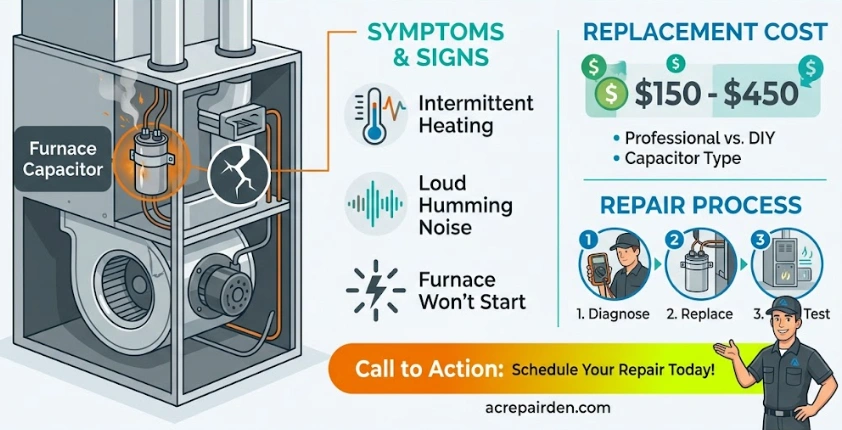
Typical furnace capacitor replacement costs run $150 to $400 for professional service in the Denver metro, parts and labor included. The capacitor itself is $10 to $40. The most common bad furnace capacitor symptoms to watch for: a furnace not blowing hot air, a blower motor that hums but won’t start, and short cycling. You can test the capacitor with a multimeter, but always discharge it safely first. If that step gives you pause, call a local HVAC tech before the problem puts your blower motor at risk.
Top Takeaways
- Furnace capacitor replacement cost for professional service: $150 to $400. DIY parts run $10 to $40.
- The five symptoms that point to a bad capacitor: furnace not blowing hot air, a blower motor that hums without starting, short cycling, clicking or buzzing near the blower compartment, and a burning or electrical smell
- Testing requires a multimeter set to capacitance mode (μF). Cut power at the breaker and discharge the capacitor before you touch any terminals.
- A failed capacitor that goes unrepaired often burns out the blower motor. That’s a $400 to $600 fix instead of a $150 to $400 one.
- Colorado’s temperature range puts more wear on HVAC components than most states. Get your furnace tuned up before winter starts, not after it already has.
Understanding how a central heating furnace and its air filters works gives you a head start on spotting problems early and a clearer picture when you talk to your technician.
Table of Contents
What Does a Furnace Capacitor Do?
A furnace capacitor is a small electrical component that stores and releases energy to start and keep your furnace blower motor running. Without it, the motor can’t build the torque to spin up. No torque, no airflow. No airflow, no heat reaching your living spaces.
Two types show up in residential furnaces:
- A start capacitor delivers the burst of energy that gets the motor turning.
- A run capacitor keeps the motor at a steady, efficient speed once it’s up and running.
- Some furnaces use a dual-run capacitor that does both in a single unit. That’s the most common setup we see in residential systems across Denver.
When the capacitor weakens, the motor fights for every cycle. You get a furnace that hums, starts and stops without finishing a heating cycle, or stops moving air entirely. Those early symptoms are the capacitor giving you a warning. Most other components fail without one.
7 Bad Furnace Capacitor Symptoms We See in the Field
These are the furnace capacitor failure signs our techs flag most on no-heat calls across Denver and the surrounding area. Catch one of these early and you’re looking at a straightforward fix:
- Furnace not blowing hot air. The motor runs but can’t hit full speed, so warm air never makes it through the duct system.
- Blower motor hums but won’t start. The motor has power but can’t get moving. That’s the most reliable bad capacitor sign we see in the field.
- Short cycling. The furnace kicks on, runs briefly, shuts off, and tries again. It keeps working against itself.
- Clicking or buzzing sounds. Unusual electrical noise from the blower compartment usually means the capacitor is struggling to hold or release a charge.
- Complete failure to start. When the capacitor fails entirely, the motor gets no usable energy and the furnace won’t run at all.
- Burning or electrical smell. An overheating capacitor has a distinct smell. Cut power immediately and call a technician.
- Repeated breaker trips. The motor draws excess current trying to compensate for a weak capacitor, and the breaker trips each time.
We see symptoms one, two, and three misdiagnosed as thermostat problems or dirty filters all the time. Usually the filter’s fine. If your furnace still isn’t heating properly, the capacitor is what to check next.
How to Test a Furnace Capacitor
A hands-on homeowner can test a furnace capacitor. Take the safety steps seriously, though. A charged capacitor holds dangerous voltage even with the furnace powered completely off.
Safety first: cut power at the breaker before you touch anything.
- Locate the capacitor. It’s in the blower compartment, usually a cylindrical or oval component mounted near the motor with two or more terminals.
- Discharge the capacitor. Bridge an insulated screwdriver across the terminals to safely release any stored charge.
- Set your multimeter to capacitance mode. Look for μF or CAP on the dial.
- Touch the probes to the capacitor terminals and read the display.
- Compare your reading to the rated capacitance printed on the capacitor label.
- A reading more than 6% below the rated value means it’s time to replace the furnace run capacitor. The part is failing.
When the reading doesn’t match up, call us. Our Denver team diagnoses and replaces the part in a single visit. Click or tap here to schedule.
Furnace Capacitor Replacement Cost: What Denver Homeowners Pay
For a DIY repair, the capacitor runs $10 to $40 at most HVAC supply stores. Budget another $20 to $30 for a basic multimeter if you don’t already own one.
Professional HVAC capacitor replacement in the Denver metro runs $150 to $400 all-in, covering the service call, labor, and the part. After-hours and emergency calls run higher than standard rates.
What moves the final furnace capacitor cost near me:
- Capacitor type: start, run, or dual-run
- Your furnace brand and the specific part it requires
- Time of the call: standard hours vs. emergency or after-hours service
- Whether the tech finds additional wear on the blower motor or nearby components during the visit
One number worth keeping in mind: blower motor replacement runs $400 to $600 or more. A capacitor repair now costs a fraction of that. Waiting rarely saves money.
DIY or Professional Furnace Capacitor Repair?
Honest answer: it depends. Replacing a capacitor is one of the more accessible HVAC repairs. The part is inexpensive, the process is clear, and you don’t need anything beyond a multimeter and a screwdriver.
A few things that push the decision toward a professional:
- Discharge risk is real. Skip that step or rush it, and you risk a serious electrical shock.
- A failing capacitor often stresses the blower motor. A tech checks motor health during the same visit. A DIY repair can miss wear that’s already building.
- Some manufacturers require certified service for all repairs. A DIY capacitor swap could void your furnace warranty.
Capable with electrical work and clear on the discharge steps? Replacing a furnace run capacitor yourself is a reasonable call. Our Denver team is also available for the repair. Get in touch and we’ll get it done.
Why Denver Homeowners Call AC Repair Den for Furnace Capacitor Work
We service furnaces across Denver, Aurora, Littleton, and the Front Range. Colorado winters are hard, the temperature swings are wide, and the dry air adds to the wear. Higher-MERV furnace filters and long run times increase pressure drop and stress on HVAC components here more than in most parts of the country, and we know which parts fail first.
A furnace capacitor repair call with us isn’t just a part swap. We test the blower motor, check the electrical system, and flag anything else showing wear before we close the job. Catching a secondary problem on this visit beats having you call us back in two weeks with a bigger one.

“A furnace capacitor fails quietly. The furnace still runs, but you start to notice the air isn’t quite as warm and the system seems to struggle more than it should. By the time it stops working entirely, the motor has often been stressed for weeks. We always tell homeowners: if your heat seems off, don’t wait for a complete breakdown to call a tech. The earlier you catch it, the less it costs to fix.”
7 Essential Resources
These are the resources we point homeowners to when they want to go deeper on furnace systems, HVAC safety, and technician standards:
- U.S. Department of Energy: Furnaces and Boilers — How your furnace system works and what to look for when it’s time to repair or upgrade.
- U.S. Environmental Protection Agency: Indoor Air Quality — Your HVAC system directly affects the air quality inside your home. The EPA’s guidance covers what’s at stake when systems aren’t maintained — including the impact of dirty air filters on indoor comfort and air quality.
- ENERGY STAR: Heating and Cooling Products — Compare certified heating and cooling equipment for efficiency ratings and long-term value.
- North American Technician Excellence (NATE): Why NATE Certification Matters — What NATE certification means and why it matters when you’re choosing an HVAC technician.
- Air Conditioning Contractors of America (ACCA): Consumer Resources — HVAC contractor standards, how to select a qualified technician, and what to expect from a professional service call.
- U.S. Consumer Product Safety Commission: Home Heating Safety — Safety information for homeowners using gas furnaces and other residential heating systems.
- ASHRAE: Residential HVAC Technical Resources — Industry standards and guidelines from the leading professional organization in HVAC engineering and design.
3 Statistics Worth Knowing
- Space heating accounts for approximately 45% of total home energy use in a typical U.S. household, making furnace health one of the highest-impact home maintenance decisions a homeowner makes. (U.S. Energy Information Administration: Use of Energy in U.S. Homes)
- Indoor air can be two to five times more polluted than outdoor air, and a functioning HVAC system, including a working blower motor and capacitor, and MERV-rated air filters, is one of the primary defenses against that buildup. (U.S. Environmental Protection Agency: Report on the Environment, Indoor Air Quality)
- About 47% of U.S. homes use natural gas as their primary heating fuel, with forced-air furnace systems as the dominant delivery method. Tens of millions of homes depend on a working blower motor and capacitor to stay warm every winter. (U.S. Census Bureau: Housing and Heating)
Final Thoughts
Space heating accounts for approximately 45% of total home energy use in a typical U.S. household, making clean pleated furnace filters and overall furnace health one of the highest-impact home maintenance decisions a homeowner makes.
Call a capacitor failure what it is: a fixable problem that costs $10 to $40 in parts and one service visit to resolve. The catch is that a capacitor that’s been weakening for weeks puts the blower motor under strain you can’t see from the outside. Wait long enough and you’re not replacing a $40 part anymore.
Safety matters here too. Capacitors hold charge after the power is cut. Skipping the discharge step isn’t a shortcut. And if you’re in Denver heading into a Colorado winter, the time to deal with a weak capacitor is before the temperature drops, not at 10 PM when the heat fails.
Know the bad furnace capacitor symptoms and test it early if you can do it safely. Keeping up with clean, high-quality furnace filters is another simple way to protect your blower motor and keep airflow strong. Upgrading to pleated MERV 8 filters that capture more dust is one of the easiest ways to keep your furnace cleaner between service visits. Whether you handle the furnace capacitor repair yourself or call a tech, acting before the problem compounds is always the smarter move. The homeowners who wait for a full breakdown always tell us they wish they’d called sooner.
Frequently Asked Questions
How do I know if my furnace capacitor is bad?
The most reliable bad furnace capacitor symptoms are a furnace not blowing hot air, a blower motor that hums without starting, and short cycling. You might also hear clicking or buzzing from the blower compartment, or catch a burning smell near the unit. Confirm it with a multimeter. A reading more than 6% below the rated capacitance on the label means the part needs to be replaced.
How much does furnace capacitor replacement cost?
Professional furnace capacitor replacement typically runs $150 to $400, covering the service call, labor, and the part. The capacitor itself costs $10 to $40. Price varies by capacitor type, furnace brand, and whether the call is standard or after-hours.
Can a bad capacitor cause my furnace not to blow hot air?
Yes, and it’s one of the most common causes. When the capacitor can’t power the blower motor at full speed, airflow drops. The warm air coming off the heat exchanger never makes it through the ducts. The furnace runs. The heat doesn’t reach you.
How long does a furnace capacitor last?
Most capacitors last 10 to 20 years, depending on usage, local climate, and how consistently the system gets maintained. In Colorado, where temperature extremes put added stress on HVAC components, they tend to wear toward the shorter end of that range. Annual tune-ups and keeping spare furnace filters on hand catch early degradation before it becomes a no-heat call.
Is replacing a furnace capacitor a DIY job?
It can be, if you’re comfortable with basic electrical work and know how to safely discharge the capacitor before touching any terminals. If either of those steps feels uncertain, call a licensed tech. The professional cost is manageable, and a tech checks the blower motor at the same time, which matters if the capacitor has been failing slowly.
What happens if I run my furnace with a bad capacitor?
The blower motor works much harder to compensate for the weak capacitor. That extra load generates excess heat and pulls more current than the motor is built to handle. Over a few weeks, that strain can damage or burn out the motor entirely, turning a straightforward capacitor repair into a much more expensive motor replacement.
What’s the difference between a start capacitor and a run capacitor?
A start capacitor delivers the jolt that gets the blower motor moving. A run capacitor keeps it spinning at a consistent speed once it’s up. Some furnaces use a dual-run capacitor that handles both jobs in a single unit. When we’re diagnosing a furnace not blowing hot air or a blower motor that hums without turning, the capacitor type helps us pinpoint the exact failure pattern.
Spotted Bad Furnace Capacitor Symptoms? Let’s Fix It Before Your Heat Fails.
Your furnace capacitor replacement cost is a fraction of what a burned-out blower motor runs, and our Denver team can diagnose and replace the part in a single visit. Click or tap here to schedule your furnace capacitor repair with AC Repair Den today.